

If you’ve lived in Edmonton for more than a couple of years, you’ve probably noticed that the weather rarely stays the same for long.
A bright, sunny morning can turn into a heavy afternoon thunderstorm. Winter temperatures might hover around freezing one day before plunging below -25°C the next. Spring often feels like a battle between melting snow and another surprise snowfall.
While most people think about these weather swings in terms of driving conditions or heating bills, they have another consequence that’s much easier to overlook: they slowly wear down your home’s exterior.
Few parts of a house experience this wear and tear more than the gutter system.
Unlike roofing or siding, gutters are constantly exposed to moving water, melting snow, ice buildup, wind, and debris. They quietly handle thousands of liters of water every year, and when they begin to fail, the damage often spreads far beyond the gutters themselves.
Many homeowners don’t notice there’s a problem until water starts overflowing during a storm or pooling beside the foundation. By then, what could have been a simple repair may have already affected other parts of the home.
Understanding how Edmonton’s climate impacts gutters can help homeowners avoid expensive repairs and significantly extend the life of their exterior.
Alberta Doesn’t Give Gutters Much of a Break
Some parts of Canada deal mostly with rain.
Others mainly battle snow.
Edmonton gets both, often with dramatic temperature changes in between.
Think about what happens during a typical year.
Winter arrives with months of snow accumulation. The roof slowly collects hundreds of kilograms of snow while gutters sit buried beneath ice.
Then spring comes.
The snow begins melting during the day before freezing again overnight.
Water expands as it freezes. Ice becomes heavier. Brackets holding the gutters experience constant stress.
That process repeats dozens of times before summer even arrives.
Then summer brings an entirely different challenge.
Instead of snow, gutters suddenly need to handle intense rainfall from thunderstorms. A roof can collect an incredible amount of water during even a short storm. If the gutter system isn’t draining efficiently, water begins looking for another route.
Usually, that route isn’t good for your house.
Freeze-Thaw Cycles Cause More Damage Than Most People Realize
Contractors who work on homes across Alberta often point to freeze-thaw cycles as one of the biggest reasons exterior materials deteriorate faster here than in many other parts of North America.
Gutters are no exception.
When temperatures rise above freezing, snow and ice begin melting.
Water flows into the gutter system.
Later that evening, temperatures fall again.
Now that same water freezes inside the gutters.
The expansion places pressure on seams, hangers, fasteners, and joints.
A homeowner won’t usually hear anything happen.
There won’t be a dramatic crack.
Instead, tiny amounts of movement occur over and over again.
Months later, a gutter that once sat perfectly against the fascia has developed a slight gap.
Another season passes.
The gap becomes larger.
Eventually, water starts running behind the gutter instead of through it.
This gradual process explains why many gutter problems seem to appear “out of nowhere.”
In reality, they’ve often been developing for years.
Heavy Rain Can Expose Problems Instantly
A gutter system might appear perfectly fine during light rain.
Then one major summer storm arrives.
Suddenly water pours over the sides.
The downspouts can’t keep up.
Some homeowners assume the rainfall was simply too heavy.
Sometimes that’s true.
More often, the storm simply exposed problems that already existed.
Leaves may have reduced water flow.
Sections of gutter might have lost their proper slope.
Older joints may no longer be watertight.
Fasteners could have loosened over time.
Heavy rain doesn’t always create gutter problems.
It often reveals them.
That’s why many roofing and exterior contractors receive their busiest call volume immediately after major storms.
Wind Is Harder on Gutters Than People Think
Edmonton regularly experiences strong winds throughout the year.
Most homeowners think about shingles blowing off roofs.
Few consider what those winds do to gutters.
Strong gusts carry branches, twigs, and debris directly onto the roof.
Everything eventually washes into the gutter system.
Even when gutters don’t become completely blocked, accumulated debris slows water movement.
Standing water becomes heavier.
Heavier gutters place additional strain on fasteners.
Eventually, small sections begin pulling away from the fascia.
Wind also creates another issue.
Large tree branches rubbing against gutters may seem harmless at first.
After months or years of repeated contact, however, those small impacts can bend sections of aluminum or loosen mounting hardware.
Clogged Gutters Create Problems All Year Long
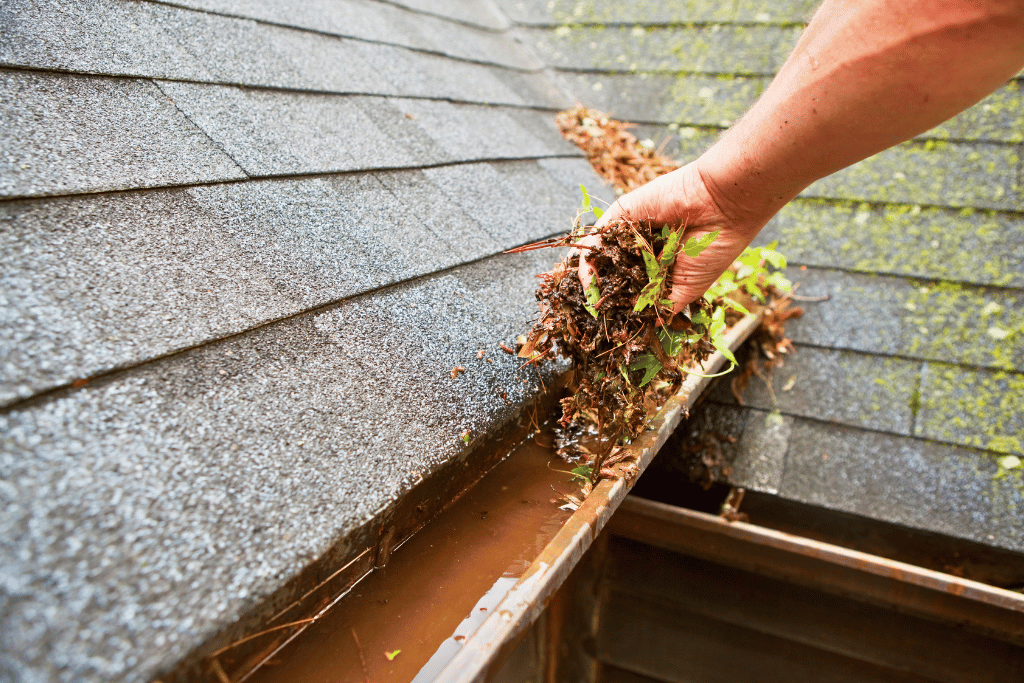
Leaves are usually blamed for clogged gutters.
They’re certainly part of the problem.
But they’re far from the only culprit.
Edmonton homeowners also deal with:
- Pine needles
- Small branches
- Helicopter seeds
- Dirt and roof granules
- Moss
- Bird nests
Over time, this material forms dense blockages.
Water no longer flows freely toward the downspouts.
Instead, it begins overflowing exactly where homeowners don’t want it.
Overflowing water often damages:
- Fascia boards
- Soffit panels
- Exterior siding
- Landscaping
- Walkways
- Foundation drainage areas
Many of these repairs cost considerably more than routine gutter maintenance.
Small Gutter Problems Rarely Stay Small
One of the biggest mistakes homeowners make is assuming a small gutter issue can wait until next year.
Sometimes it can.
Many times it shouldn’t.
Imagine one corner of a gutter separating just enough to allow a small amount of water behind it.
Every rainfall wets the same section of fascia.
The wood slowly absorbs moisture.
Paint begins peeling.
Eventually the wood softens.
Months later, the homeowner notices staining beneath the roofline.
At that point, replacing the gutter alone won’t solve the problem.
Now carpentry work may also be required.
The original issue wasn’t expensive.
Ignoring it was.
Regular Inspections Save Money
Fortunately, preventing most gutter problems doesn’t require major investments.
It starts with paying attention.
Walk around your home after a heavy rainstorm.
Watch where the water goes.
Are downspouts draining properly?
Is water spilling over the sides?
Do sections appear to sag?
Look for stains on the siding.
Check whether soil beneath downspouts is washing away.
Small observations today often prevent expensive repairs tomorrow.
Many homeowners are surprised by how much they notice once they begin looking.
Why Professional Maintenance Makes a Difference
Some maintenance tasks are perfectly suitable for homeowners.
Others benefit from experienced eyes.
Professional inspections often identify developing problems long before homeowners notice visible damage.
Loose brackets.
Incorrect slope.
Hidden leaks.
Beginning signs of corrosion.
Minor alignment issues.
These aren’t always obvious from the ground.
Companies specializing in gutter repair in Edmonton often discover concerns that can be corrected quickly before they affect surrounding exterior components.
Likewise, homeowners replacing aging systems frequently choose professional gutter installation Edmonton services to ensure proper sizing, drainage, and long-term performance based on Alberta’s unique weather conditions.
Choosing the Right Gutter System Matters
Not every home requires the same gutter configuration.
Roof size, pitch, surrounding trees, and drainage patterns all influence system performance.
Modern seamless aluminum gutters have become increasingly popular because they reduce the number of joints where leaks commonly develop.
Properly sized downspouts improve drainage during heavy storms.
High-quality fasteners help the system withstand years of snow loads and freeze-thaw cycles.
The goal isn’t simply installing new gutters.
It’s creating a system capable of performing reliably through Alberta’s changing seasons.
Protecting Your Home Starts at the Roofline
Most homeowners think about gutters only when they stop working.
That’s understandable.
When a gutter system functions properly, it’s almost invisible.
Rainwater disappears.
Snowmelt drains safely away from the house.
The foundation stays dry.
The landscaping remains intact.
Everything works exactly as intended.
Yet those quiet, dependable systems don’t happen by accident.
They result from regular maintenance, timely repairs, and quality installation.
Edmonton’s weather isn’t something homeowners can control.
But they can control how well their homes are prepared for it.
Taking care of your gutters today may not feel like the most exciting home improvement project. It may, however, be one of the smartest. A properly maintained gutter system helps protect your roof, foundation, siding, soffit, fascia, and landscaping all at once, making it one of the best investments you can make in your home’s long-term health.